How it works
The Career Lab supports students through a guided professional preparation pathway. The process starts with the collection of useful materials, such as a profile form, CV and video interview, and leads to the production of a formative report with observations and suggestions for improvement.
The goal is not to automate an assessment, nor to decide whether a person is suitable or unsuitable for a role. The Career Lab helps make clearer the way students describe their skills, experiences, goals and professional potential.
Each step is designed to keep human control in place: AI supports the analysis, but the teacher or tutor interprets the result, validates it and uses it as a basis for formative feedback.
From Anonymised Profile to Formative Report
The Career Lab follows a simple and controlled process. First, the student's materials are collected, then an anonymised profile is created, and finally the system analyses text, voice and video to produce an initial draft of the report.
The report is never automatically delivered to the student. It is first read, verified and validated by the tutor. Only after this step does it become a valuable tool for formative discussion.
This approach allows AI to be used as a support for teaching, without turning it into an automated judgment system.
A Guided, Not Automatic Journey
The Career Lab functions as a didactic laboratory. Students are not left alone in front of an automated tool, but are accompanied by educators who understand the training context and the objectives of the program.
The system helps organize information, analyze communicative elements, and produce an initial feedback draft. This draft is not the final result: it serves as a working foundation for teachers and tutors.
The value of this journey stems from the integration of technology, educational methodology, and human discussion. AI accelerates the analysis, but the final feedback remains formative, contextualized, and supervised.

The educational value comes from discussion: the tutor interprets the report and supports the student's growth path.
The Role of the Tutor
The tutor plays a central role throughout the entire process. Rather than simply using the platform, they support students during preparation, material collection, and the review of the report.
Specifically, the tutor:
- gathers and organizes the necessary materials;
- creates the student's anonymised profile;
- links the CV, profile form, and video interview to the identification code;
- initiates the AI-assisted processing;
- reviews the generated report;
- can integrate, modify, or validate the report;
- delivers clear and constructive feedback to the student.
This step ensures that the report is not perceived as an automated judgment, but as a supportive tool for self-improvement.
Key Steps
The Career Lab process can be outlined in five main steps.
Material Collection
Relevant elements are gathered: profile form, CV, experiences, goals, and video interview.
Anonymous Profile
The system links materials to an identification code, without using direct personal data.
Upload & Analysis
The tutor uploads the files and starts the assisted analysis. AI reviews text, voice, and video elements.
Report Generation
AI generates an initial training report draft consisting of constructive observations and recommendations.
Validation
The tutor verifies the report, adds to or modifies it, and discusses it during the student feedback session.
What is Collected
The process begins by gathering materials that outline the student's profile and self-presentation approach.
Materials include:
- a structured profile form, education history information, and goals;
- internship, work, or practical experience and soft skills;
- a video interview or mock interview.
How Identity is Protected
Prior to analysis, the system creates a profile identified solely by a code. This links all materials to the same track without exposing direct personal identity data within the analysis platform.
The code does not impact the educational relationship: the tutor knows which student matches the track, but the system processes materials securely and non-identifiably.
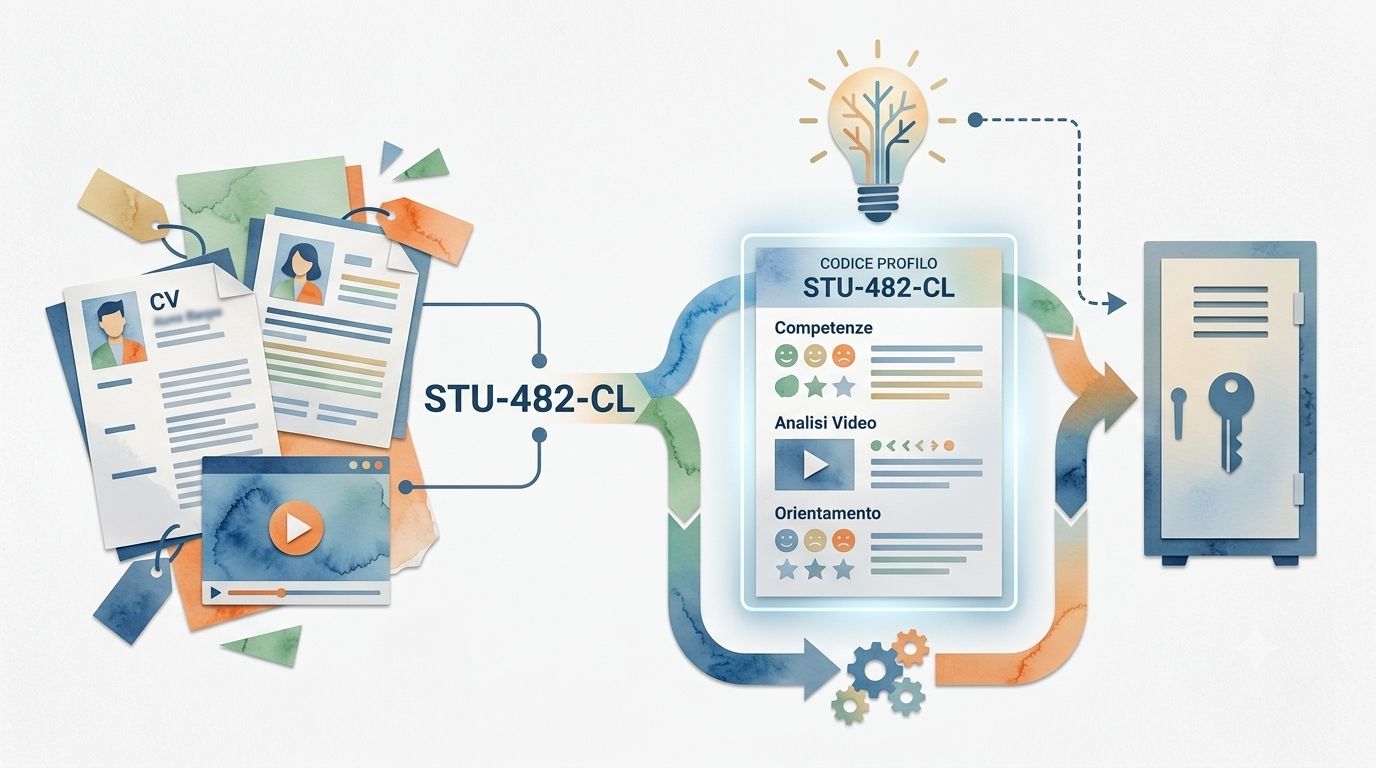
Secure separation: personal data remains protected; AI processes only materials linked to an ID code.
How the Report is Made
Once materials are uploaded, the tutor runs the AI-assisted processing. The system analyzes the available components and delivers an initial structured output.
The analysis can evaluate:
- clarity of content, answer structure, and alignment with professional goals;
- presentation quality, pacing, spoken clarity, and observable video elements;
- potential areas for communication enhancement.
The outcome is a training report. It is not an automated evaluation, but a foundation for teamwork that helps tutors and students spot strengths, clarification points, and steps for improvement.
From Process to Progress
Each phase of the process serves a clear purpose. The Career Lab does not collect materials just for storage, but to translate them into actionable insights for the student's professional growth.
| Phase | Educational Value |
|---|---|
| Material collection | Helps students retrace experiences, skills, and goals in an organized manner. |
| Anonymous profile | Protects privacy and allows content review without a central focus on personal details. |
| CV and video upload | Enables review of both what the student says and how they communicate it. |
| AI-assisted analysis | Organizes information and identifies useful pointers for feedback. |
| Training report | Translates analysis into actionable insights and suggestions for improvement. |
| Tutor validation | Ensures human oversight, an educational context, and non-automated delivery. |
| Student discussion | Fosters self-awareness, readiness, and better self-presentation skills. |
What Does Not Happen
To ensure a proper, transparent process aligned with its educational mission, the Career Lab does not use AI as an automated selection system.
The platform does not:
- decide if a student is suitable for a job, nor does it assign scores or rankings;
- replace teachers, tutors, or counselors in their relationship-building role;
- make personality judgments or send students outputs that have not been validated by a human.
Why This Journey is Valuable
Preparing for work also means learning how to articulate what you can do. Many students possess experiences, skills, and potentials that they don't always communicate clearly in an interview or on their profile presentation.
The Career Lab targets three practical goals:
- Increasing self-awareness regarding one's track;
- Enhancing professional communication quality;
- Preparing with a more systematic method for interviews, internships, and future opportunities.
The expected outcome is not a flawless presentation, but progressive advancement. Students learn what works, what can be made clearer, and what steps they can take to better prepare for their professional future.